Blog

Loggia House / House of Em

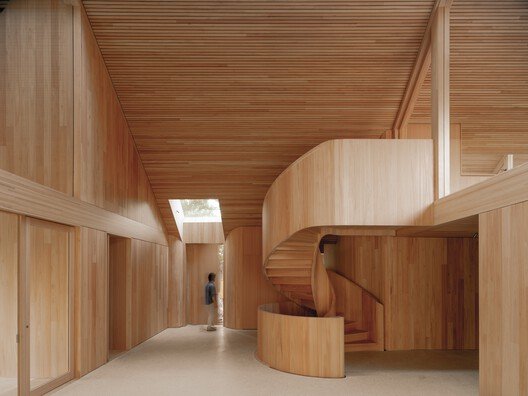
London-based architecture and interiors studio House Of EM – the new practice by former Michaelis Boyd directors Emma Bodie and Matthew Sanders – has completed a renovation and extension in Kensal Rise for a young family of four. Designed for clients Anthony and Roberta, Loggia House includes a ground-floor rear extension, internal alterations throughout, and preparatory work for a future dormer extension, all enhancing scale and functionality for the family to enjoy.

Read More »

School in Dunkerque / TANK Architectes

TANK has completed the « L’Alliance », a modular school in Dunkerque, France. The new construction includes an agora, a seven-classroom nursery, an eight-classroom elementary school, a cafeteria, a community center, a multipurpose hall divisible into smaller spaces, a cybercenter, offices, a civic hall, and outdoor areas.

Read More »

Mashiach Now Square / Natureza Urbana

The revitalization of Praça Mashiach Now has transformed a degraded space in the Northern Zone of São Paulo into an urban green infrastructure, coordinating environmental recovery, active mobility, and social activation in a territory historically dominated by automobiles.

Read More »

Nok-Khok House / Yangnar Studio

“Nork-Kok,” a Thai expression meaning unconventional or outside the norm, does not suggest a lack of order but instead honestly reflects the character of both the place and its owner.

Read More »

Decomposition as Expression: Disassembled Axonometry as Design Tool

In the translation of three-dimensional reality onto a two-dimensional plane, axonometry stands as one of the graphic systems of representation that form the foundation of the language used by architecture and design professionals. Alongside plans, sections, and elevations, its exploded views often stand out for their ability to study the multiple layers that compose a project. Although axonometry is also employed in other disciplines such as engineering and urban planning, it consistently proves its capacity to function as more than a mere representational tool, strengthening the understanding not only of a project’s construction processes, materials, and structural systems but also expanding the communication of the ideas and design processes that shape a project.

Read More »

OneTwoHouse / rundzwei Architekten

The OneTwoHouse (German: EinZweiHaus) is a residential building whose exterior form creates an optical illusion: Although it appears to be a semi-detached house, it is in fact a single-family home. The staggered volumes and symmetrical façade create the impression of two separate units that are, however, united under one roof.

Read More »

21-24 Nikkakjøkken Restaurant / OFFICE INAINN

Function as an insert, not a rebuild – The original envelope remains; a lightweight core delivers the restaurant programme. Conceived as an independent module built entirely in timber, it is not intended to be immediately reversible in situ, but is designed for future demounting without harm to the historic shell.

Read More »

House Macana / Taller Carlos Marín

When we first visited the site, what struck us the most was that after emerging from a narrow alley, an extraordinary view opened up toward one of the slopes of the Tepozteco mountain range. These rock formations are emblematic of the region, and the land ends precisely at the base of this dramatic topography. From the very beginning, one of our main concerns was to ensure that every room—whether for gathering or resting—could enjoy this privileged view.

Read More »

Villa Boso / Kenichi Teramoto / office of Teramoto

Zero-Concrete Architecture: A New Vernacular – Vernacular architecture existed long before concrete. Across regions and climates, it evolved through local materials, gravity, craft, and accumulated knowledge—without relying on reinforced concrete as a universal solution. This villa is built entirely without concrete. The project is conceived as a contemporary reinterpretation of vernacular architecture and as a continuation of a critical inquiry into modern, concrete-dependent construction culture.

Read More »

Residence on the Edge of National Forest / Studio GAB

The main idea behind the house design was to fit an extensive functional program into a long plot bordering the Wielkopolska National Park while maximizing daylight in as many living spaces as possible. This resulted in an elongated form composed of three overlapping, truncated volumes. An equally important goal was dividing the house into lifestyle-based zones so that, despite its size, it would not dominate the surrounding development. Through careful layout and use of local conditions, the house blends naturally into its context.

Read More »