Latest News

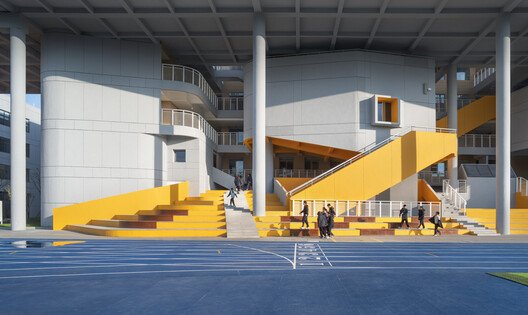
Kangsheng Road Education Complex / SEU-ARCH + ZRADI + UA GROUP

The complex consists of a 24-class junior high school, a 30-class primary school, and a 24-class kindergarten, arranged sequentially from south to north, with integrated basements. The three principal architects in charge of the design engaged in an interesting “design dialogue,” balancing division of labor and collaboration. Given their close relationship, the junior high and primary schools agreed on a coordinated master plan. Both structures adopt a “sandwich”-like layout. First, the dimensions of the connecting body at critical junctions are strictly controlled. Then, each is free to develop its own expression. The junior high and primary school buildings are divided longitudinally into three functional spaces. Arranged from west to east are auxiliary teaching space, main teaching space, and extracurricular interest space.

Read More »

Meet the 15 Winning Projects of the 2026 ArchDaily Building of the Year Awards

A revitalized canning factory in a coastal Portuguese city, a memorial park in Ethiopia, a small-town Brazilian home, a wooden pavilion evoking Bahrain’s heritage, and 11 other visionary projects comprise the winners of the 2026 ArchDaily Building of the Year Awards. Chosen over three weeks of public voting, the winners are representative of the current architectural landscape, reflecting a diversity of approaches, materialities and aesthetics, while also showcasing common threads across cultures.

Read More »

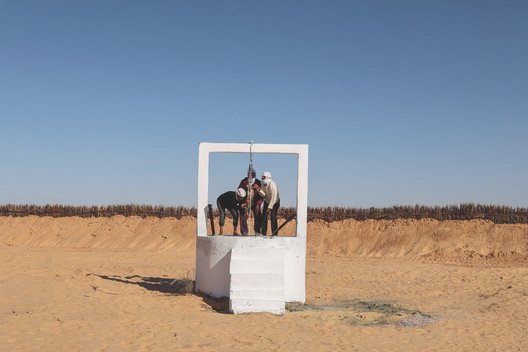
Land of Wells: Designing for Saharan Nomads

In some languages, the very word for building refers to its immovability. The discipline of engineering related to buildings is referred to as statics. Thus, architecture is closely related to the fixed and the immobile. And yet, for millions of nomadic people around the world, shelters must be of a light and distinctly movable structure, while home is the vast landscape in which they reside. Such lifestyles, which carry centuries of traditions, are constantly under threat from the pull factors of sedentary life in towns and cities. In Tunisia, one project acknowledges the risk of heritage loss and attempts to improve conditions for nomadic herders.

Read More »

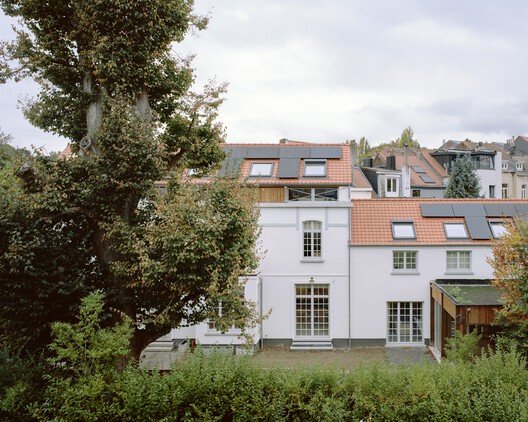
Crabe Fantôme – Evolutive Housing / O.U.V.R.A.G.E.S.

The project transforms a former neighborhood restaurant in Watermael-Boitsfort (Brussels, BE) into a set of adaptable dwellings, rooted in the heritage value of the existing building. In an uncertain ecological and economic context, reprogramming such a building for a single, fixed use appears increasingly inadequate. The project therefore rejects a deterministic approach in favor of a restrained, legible, and forward-looking architectural strategy.

Read More »

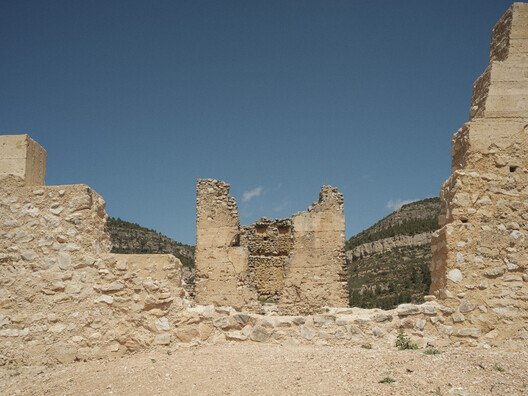
Chera Castle / Belen Ilarri Studio

The project involves the restoration of a castle, designated as a Cultural Heritage Site, located in the Chera-Sot de Chera Natural Park, Valencia. This 12th-century structure, from the Almohad period, fell into ruin over successive historical periods and was definitively abandoned at the beginning of the 19th century.

Read More »

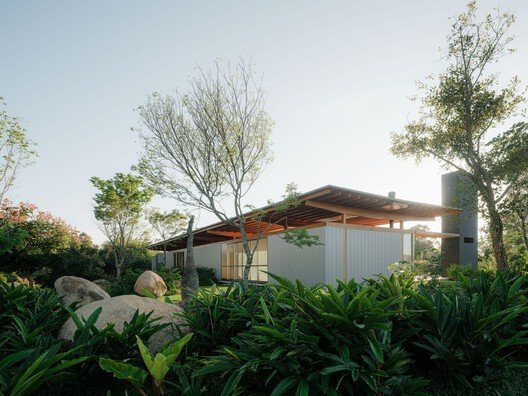
Itupeva House / UNA MUNIZVIEGAS

Visits to the site sparked the desire to build a house that would blend into the landscape. We found large rocks on the land, which is protected by dense vegetation, that protruded from the steep slope of the southern portion. There’s also a lake nearby, accessible via a short trail through the woods.

Read More »

Between Materials and Memory: Three Madrid Architecture Practices on Heritage Rehabilitation

The role of heritage rehabilitation in the contemporary architectural landscape is shaped by a wide range of research, beliefs, memories, and efforts aimed at redefining and strengthening our built environment. When undertaking a transformation, renovation, or preservation project, architects can employ diverse strategies and tools to encourage a meaningful coexistence between what already exists and what is newly introduced. Together with three Madrid-based architecture practices—SOLAR, Pachón-Paredes, and BA-RRO—we set out to engage in conversation and explore their creative processes and ideals, recognizing the complexity and value of historic buildings as repositories of materials, structures, and construction techniques from other eras.

Read More »

Dollhouse Loft / StudioAC

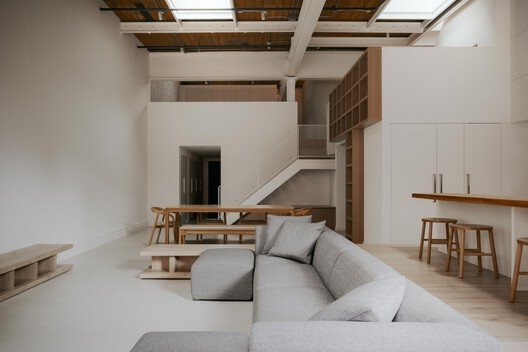
Located in Leslieville, in Toronto’s east end, this loft renewal project set out to enhance the interior both aesthetically and functionally. Once a toy and bottling factory throughout the 1900s, the building became live/work lofts in the early 2000s. As time wore down the quality of finishes and fixtures, a new opportunity emerged to rework the loft’s spatial dynamics.

Read More »

Sornells 21 Studio / Paloma Bau Studio

Ausiàs Pérez of T.O.T Studio and Paloma Bau open the doors to Sornells 21, their shared studio in the Valencian neighborhood of Ruzafa, transforming a former commercial unit into a creative workspace inspired by the urban imagination of Tokyo. The intervention combines a strong conceptual narrative with a carefully executed material strategy, shaping a place where design, community and creativity converge.

Read More »