
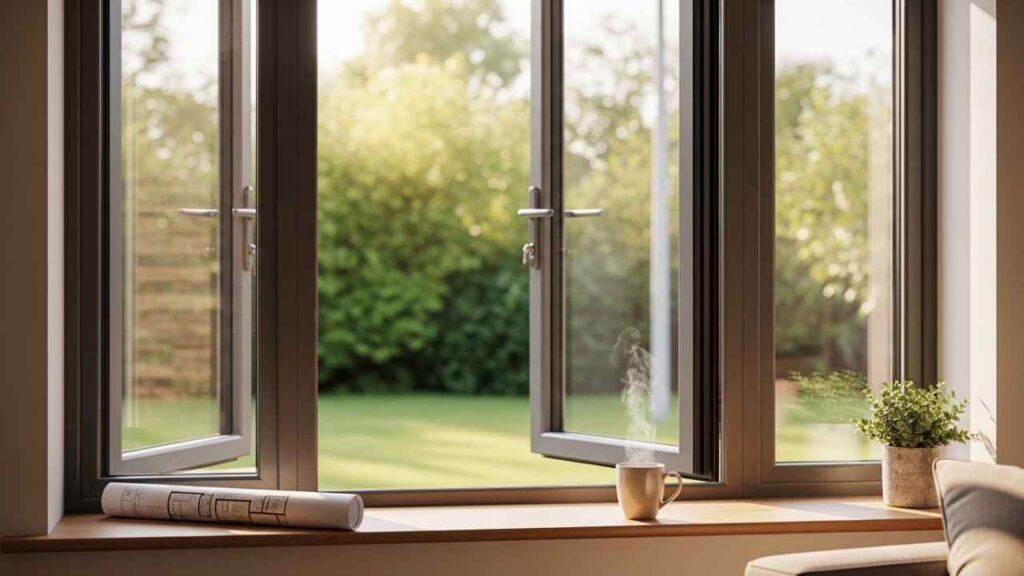
The ongoing rise of energy costs, which affects numerous households, requires people to verify that their window systems maintain indoor heat throughout their residences. The following information explains how to select the correct window products, which will create an environmentally sustainable house.
The main point we need to establish at the beginning needs to be stated clearly. Glazing produces lower thermal efficiency when compared to solid wall materials. The situation exists in its current form. Modern windows create comfortable indoor environments because their heating technology has developed significantly over the last ten years.
Proper window specifications become essential when you construct a new house, expand your existing building, or replace your aging window frames. The proper specification for window installation requires your complete focus because it determines overall project success. The most expensive window, which you can acquire from the market, will not deliver its full performance potential because improper installation leads to what experts describe as “performance gap results.” The window does not meet its expected operational standards because of this problem.
The following section will provide clear answers to two main questions that exist about energy-efficient window specifications.
What are U-values, and why should you care?
U-values function as a measurement tool that assesses how much heat will escape through a building element. U-values require measurement in watts per meter squared Kelvin, which seems complex, yet their principal aspect shows that lower values indicate superior performance.
A well-insulated wall reaches a U-value range between 0.10 and 0.16 W/m²K. The U-value of a single-glazed window reaches approximately 5.0 W/m²K. The difference between these two values represents a substantial gap. Windows historically function as a major weakness, which reduces a home’s ability to maintain interior warmth.
Architects and designers use these values to determine the thermal performance of your entire home. The data impacts choices regarding heating systems, which type of insulation to use, and whether mechanical ventilation will become necessary. The certification requires you to meet specific U-value requirements when you pursue Passivhaus certification, which functions as an advanced eco-standard. Certification authorities do not permit any exceptions to their requirements.
What U-value should you be looking for?
High-performance windows typically deliver U-values somewhere between 0.6 W/m²K—that’s the very best triple-glazed products—and 1.2 to 1.6 W/m²K for standard double glazing.
Building regulations for new homes in the UK currently require windows to have a U-value of 1.2 W/m²K or better, with doors needing to achieve 1.0 W/m²K. But here’s the thing—regulations are just a minimum standard. If you’re serious about creating a highly efficient home, you’ll want to aim higher than that. Passivhaus design, for instance, demands windows with a U-value below 0.8 W/m²K.
One crucial piece of advice: always check what the quoted U-value actually refers to. Some manufacturers might proudly display a fantastic figure, only for you to discover that’s just the centre-pane measurement. What you really need is the whole-window U-value, which takes into account the frame, the seals, and the edge spacers. That’s the real-world performance you’ll actually experience.
Understanding the terminology
Shopping for windows can feel like wading through alphabet soup. Here’s a quick guide to what all those terms actually mean:
U-value – The overall heat loss through the whole unit. Lower is better.
Ug-value – This refers specifically to heat loss through the glass itself.
Uw-value – The heat loss through the entire glazed unit, including the frame. This is the one that really matters.
Low-e coatings – These are microscopically thin coatings applied to glass that reduce heat loss without stopping light from coming through. Clever stuff.
Gas fills – The space between panes is often filled with argon or krypton gas. These are denser than air and help to minimise heat transfer.
Triple glazing – Three panes of glass instead of the standard two. It generally offers better performance, though it’s heavier and often more expensive.
Energy rating – The British Fenestration Rating Council provides ratings from A++ down to E. They assess the whole window, including how much heat it loses and how much solar gain it might provide.
It’s not just about U-values
Here’s something that’s easy to forget when you’re buried in specification sheets and technical data. Windows aren’t just about keeping heat in. They’re also about letting light in, providing ventilation, and connecting you with the outside world.
A truly great window does all of these things well. It brings natural brightness into your home, which is proven to boost mood and well-being. It allows for useful solar gain on sunny days, even in winter. And it should open smoothly to let fresh air circulate, helping to prevent condensation and maintain healthy indoor air quality.
Most self-builders and renovators want to invest in the best quality they can afford. That’s entirely sensible. But quality isn’t just about thermal performance. Look for robust seals that will keep working year after year. Check that the hardware feels solid and operates smoothly. Consider how the window will look on your home – because you’ll be looking at it for a very long time.
Installation matters enormously
You could buy the most efficient window on the market, with U-values that would make a Passivhaus designer weep with joy. But if it’s installed poorly, with gaps in the insulation around the frame and poorly taped membranes, you’ve wasted your money.
Proper installation means careful attention to the junction between the window frame and the wall. It means continuous insulation, proper airtightness tapes, and making sure any cavities are correctly sealed. This isn’t glamorous work, but it’s absolutely vital.
Some manufacturers offer an installation service or can recommend approved installers who understand their products. That’s often worth considering, because if something does go wrong, there’s no argument about who’s responsible.
Making your choice
So, where does that leave you? First, you should define your complete project objectives. Do you need to obtain a particular certification? Do you need to work within a defined financial limit? Do you have a strong preference for certain materials, which include timber, aluminium-clad, and uPVC?
You should contact multiple suppliers. You should request complete window U-value measurements instead of receiving only centre-pane measurements. You need to verify which guarantees the product and installation services provide. You should feel comfortable requesting references and viewing examples of their completed projects. Windows function as a permanent investment because of their extended lifespan.
Your decision will affect your life for the next thirty years. Take your time to research window options which will provide warmth, natural light, and long-lasting beauty throughout the upcoming years. An eco-friendly home must achieve energy efficiency, but it requires more. The goal is to design a space which provides users with maximum comfort and health benefits while delivering maximum satisfaction. The appropriate windows create a significant impact on the overall outcome.