Blog

The Line of Fragile Radiance: Neon Light as Atelier, Architecture, and Archive

The fragility—and temporal beauty—of neon has captivated audiences since the early 1900s. First shown commercially by French engineer Georges Claude at the 1910 Paris Motor Show, neon spread rapidly, achieving broad popularity in the United States from the 1920s through the 1950s. Mid-century America saw it everywhere: from the casinos of the Las Vegas Strip to roadside motor inns along Route 66 and the spectacle of Times Square. By the latter half of the century, however, many signs were scrapped or left to decay, and numerous municipalities restricted neon as visually garish or power-hungry—despite the technology’s comparatively modest energy use. In the U.S., renewed interest in neon arguably didn’t meaningfully return until the early 2000s.

Read More »

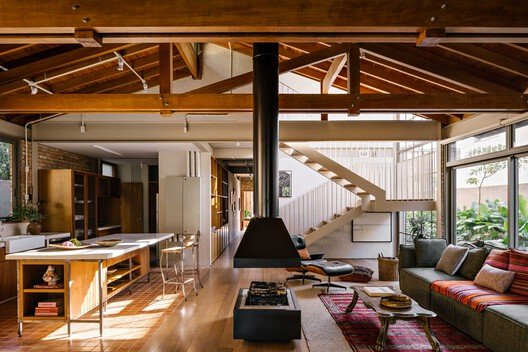
La Memoire Residence / Studio PHH Architects

Loaded with history and on a fragile but dramatic site, the owner’s dream of being stewards of the property while extending and renovating the home quickly became challenging. Hoppenot, founder of Studio PHH Architects, was brought onto the project after being recommended by a family friend who saw them struggle with preserving the site’s beauty and the home’s intentions as originally designed by Terry Hunziker.

Read More »

Foster + Partners’ Zayed National Museum Opens to the Public in Abu Dhabi

Zayed National Museum, the national museum of the United Arab Emirates and a major anchor of Abu Dhabi’s Saadiyat Cultural District, has opened to the public. The project was awarded to Foster + Partners following a 2007 design competition, with construction commencing the following year. Its inauguration marks a significant moment in the UAE’s cultural development, coinciding with a year that saw the opening of teamLab Phenomena Abu Dhabi and the Natural History Museum Abu Dhabi, as well as the reopening of Al Ain Museum, broadening the region’s institutional landscape.

Read More »

The Role of Architects Is Shifting: From Solitary Visionaries to Collective Activists

For a long time, architecture was understood as an essentially individual activity, dependent on the figure of a creative genius and centered on the ability to solve problems through drawing. Over time, this image began to fade. The protagonism once concentrated in a few names reached its peak during the era of the starchitects and gradually became distributed among offices, collectives, and multidisciplinary teams. Today, architects are expanding their boundaries into other fields such as gastronomy, music, design, and the corporate world, applying spatial thinking to address challenges of various kinds. As social, environmental, and political crises deepen, the role of the architect continues to evolve from a solitary author to a mediator, activist, and collective agent of transformation. This shift reflects an ethical awakening and a recognition that design, regulation, and care are inseparable dimensions of contemporary practice.

Read More »

The Grand Egyptian Museum / Heneghan Peng Architects

Internationally renowned architecture firm heneghan peng architects celebrates the official completion of its design for the Grand Egyptian Museum. Located just over one mile away from the Pyramids of Giza, the Museum is a testament to the longevity and scale of ancient Egyptian civilization and its enduring influences. Designed to house 100,000 artifacts, the Museum is the largest in the world dedicated to a single civilization. The full completion is marked by the opening of the Tutankhamen gallery, which will display the entire collection of over 5,000 artifacts to the public for the first time. heneghan peng designed the Museum in direct relation to the positioning of the pyramids, thoughtfully bridging the gap between history and modernity.

Read More »

From Factories to Futures: Adaptive Reuse in the Post-Industrial City

In cities across the world, the relics of industrial production have become the laboratories of a new urban condition. Warehouses, power plants, and shipyards, once symbols of labor and progress, now stand as vast empty shells, waiting to be reimagined. Rather than erasing these structures, architects are finding creative ways to adapt them to contemporary needs, transforming spaces of manufacture into spaces of culture, education, and community life.

Read More »

A Reborn Scenic Field Above Waves / TJAD Original Design Studio

Situated in the urban core section, the project is located along the southern bank of the Jiaojiang River, to the west of the Taizhou Bay estuary. It is adjacent to the Jiaojiang Bridge, the Submarine Sightseeing Base, and Hehe Avenue.Jiaojiang’s riverfront development coincides with the phase-out of industrial activities on both banks. Brownfield waterfront areas are undergoing comprehensive greening and transformation into livable spaces. Taking advantage of the opportunity to upgrade the seawall, the design transforms existing structures and spaces to foster a symbiotic relationship between public areas and the seawall.The design imbues the previously detached hydraulic infrastructure with multiple functions, integrating it into the city’s everyday life.

Read More »

Kalam by Paddy House / Episode architects

For 20 years, this building stood abandoned — a silent reminder of forgotten spaces and wasted potential. Yet every abandoned structure carries hidden stories waiting to be reimagined. A century-old granary, left unused for decades, has now been thoughtfully transformed into a boutique farmhouse through architectural ingenuity and carefully chosen materials. Set against the backdrop of the Western Ghats and nestled between lush paddy fields and a serene pond, Kalam embodies rustic charm and timeless beauty.

Read More »

Doca Linear Park / Natureza Urbana

The regeneration of the Linear Park of Doca, located in Belém do Pará, arises as a strategic urban intervention that combines infrastructure, landscape, and memory to reconnect the city to its waters through the enhancement of public spaces. Established over the old Igarapé das Almas — now a canal about 1.2 km long in the central median of Avenida Visconde de Sousa Franco — the project recaptures the hydric identity that historically structured the Reduto basin and which, throughout the urbanization process, has been buried under fragmented and functional logics.

Read More »