Blog

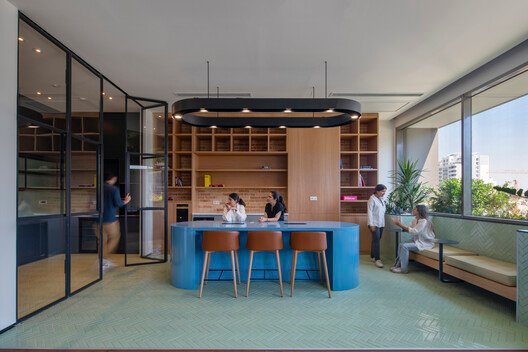
AXIS Office / moss.

“A Space Where Precision and Trust Reside” An office for a company engaged in concrete investigation, surveying, and civil engineering design. The essence of work that demands precision and reliability is translated into space through three key concepts: Precision, Reliability, and Groundedness.

Read More »

Sorairo Apartment / J HOUS STUDIO

This residence is conceived as a quiet framework for everyday life, shaped through reduction rather than expression. The design focuses on order, proportion, and light, minimizing visual interference to maintain a calm and breathable interior within a compact urban context.

Read More »

Ski Tower / A-Lab

Ski Tower is one of four towers at the Magasinparken in Ski outside Oslo. The developer Solon Eiendom AS is behind the development of this new district in Ski, which is regulated by Code Arkitekter/Civitas and which totals over 400 apartments, located in close proximity to the new train hub at Ski station on the Follo line. A-lab is one of the offices that was invited to design one of four point buildings that surround the listed old Magasin buildings on the site that was formerly a military area and the new “Urban villas” homes. The point buildings are spread out to the southwest in beautiful outdoor areas designed by Dronninga Landskap. The other point buildings are designed by the architectural offices Reilulf Ramstad, R21, and Code.

Read More »

The Evolving Practice of Designing Light in Scandinavian Environments

Scandinavia is shaped by environmental conditions that test both human endurance and architectural ingenuity, with long winters defined by limited daylight, low sun angles, deep snowfall, and cold winds that transform everyday movement, gathering, and habitation into deliberate acts. In this context, architecture is never neutral, and hospitality is never incidental. Buildings that welcome visitors across cities, forests, and coastlines must respond directly to darkness and cold, not by denying them, but by creating interior worlds that offer orientation, warmth, and psychological relief. The act of welcoming in Scandinavia is therefore inseparable from the climate, grounded in the understanding that shelter, light, and human presence are fundamental resources in Arctic environments.

Read More »

Zaha Hadid Architects Explores AI-Driven Design at “Architecture of Possibility” Exhibition in Shenzhen, China

“Architecture of Possibility: Zaha Hadid Architects” at the Museum of Contemporary Art and Urban Planning (MOCAUP) in Shenzhen, China, presents a comprehensive overview of the evolution of Zaha Hadid Architects’ work over recent decades. On view until April 10, 2026, the exhibition is structured through chronological and thematic narratives that highlight the studio’s multidisciplinary research and design methodologies. The exhibition, now open to the public, showcases the office’s work in the Shenzhen area and its involvement with new Artificial Intelligence technologies. Particular emphasis is placed on the integration of artificial intelligence (AI), immersive and interactive design tools, and virtual environments, which together form an expanding digital design ecosystem.

Read More »

Paul Clemence Captures Ingenhoven Architects’ Kö-Bogen II and Its Landmark Green Facade

In early 2025, photographer Paul Clemence documented Kö-Bogen II, a commercial and office complex designed by ingenhoven architects in Düsseldorf, Germany. The photo series focuses on the building’s signature feature: its vast green façade, considered one of the largest in Europe. Referred to as a “green heart” and an “urban mountain,” the building has become a landmark in the city due to its sloping surfaces wrapped in over 30,000 hornbeam plants. For Clemence, this was an unforeseen encounter during his first visit to Düsseldorf, which he describes as an unexpected meeting with a “stunning green pyramid.”

Read More »

Services Pavilion / VDV ARQ

In our practice, the pavilion is not a closed typology, but rather an open way of being in the territory. An architecture that does not seek to impose itself, but to enable relationships. Between the inside and the outside, between the collective and the intimate, the pavilion is always a porous structure, available, in dialogue with its surroundings.

Read More »

Narratives of Syrian Modernism: Rediscovering the Center for Marine Research

As Syria is emerging from over a decade of conflict at the time of writing, it is an opportunity to rediscover its architectural gems. Just to the north of the country’s principal port city of Latakia is a Modernist creation that is the Center for Marine Research. Its pyramidal structure is situated on a prominent headland surrounded by sea on three sides. To the east is a bay with hotels and beaches while to the north and west is the open Mediterranean Sea reaching Turkey and Cyprus beyond. Despite its importance both as a research institution and as a piece of architecture, it lies abandoned and isolated today.

Read More »

From Housing Policy in Europe to Large-Scale Master Planning in Mongolia: This Week’s Review

This week’s review focuses on concrete responses to shared urban challenges, including housing affordability, long-term resilience, and the role of cultural and material innovation in shaping cities. The selection spans regulatory measures affecting housing markets in European cities, high-density residential and mixed-income proposals in New York, and major renewal and planning efforts in London, Barcelona, Ulaanbaatar, and Drammen. It also highlights research-driven and built projects in Chicago, Buenos Aires, Las Vegas, and Riyadh that explore circular construction, adaptive reuse, and new models for cultural and public infrastructure. Together, these worldwide projects offer a snapshot of how architecture and urban planning are addressing immediate pressures while laying the groundwork for more resilient and inclusive urban futures across diverse geographic and cultural contexts.

Read More »